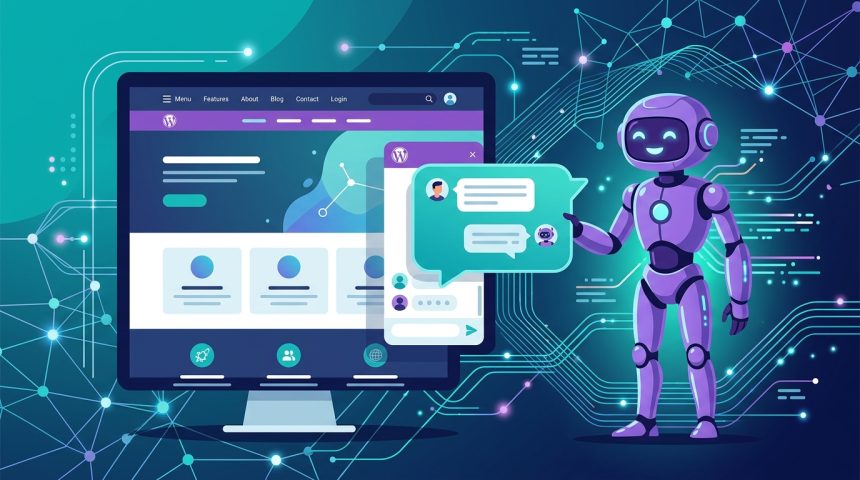
If there's one plugin that summarizes where WordPress is heading in 2026, it's AI Engine, by Jordy Meow. With more than 100,000 active installations and a rating of 4.9 out of 5, it is one of the highest-rated AI plugins for WordPress in the official repository.
What is AI Engine
AI Engine connects your WordPress with models from OpenAI, Anthropic, Google, Mistral, and other providers, to set up chatbots, generate content, or automate tasks directly from the administration panel — without leaving WordPress or depending on an external tool.
Installation and first steps
Installing AI Engine in WordPress is as simple as any other plugin from the repository: Plugins → Add New, busca “AI Engine”, instala y activa. La diferencia con otros plugins llega en el paso siguiente: AI Engine no funciona solo, necesita conectarse a un proveedor de IA, y eso requiere una API key.
The typical process is this: you create an account with your preferred provider (OpenAI is the most common to start, but Anthropic or Google work just as well), generate an API key in their developer panel, add a small credit balance, and paste the key into Meow Apps → AI Engine → environment settings. From that moment, the entire plugin becomes operational: the chatbot, content generation, and the editor assistant.
A day one tip: use the Playground of the plugin itself to test the model before exposing anything to the public. It allows you to ask questions, adjust the tone, and check the quality of responses without any visitor seeing it. If you are also starting from scratch with your website, our guide for install WordPress with AI step by step fits perfectly as a preliminary step to this plugin.
Recommended step-by-step configuration
To set up AI Engine well without surprises, this is the order we recommend:
- Choose and fix the model. In the environment settings, select a specific model instead of leaving the default one. For a basic support chatbot, a light and cheap model is more than enough; reserve large models for long content generation.
- Configure the chatbot en la pestaña Chatbots: dale un nombre, escribe unas instrucciones de sistema claras (“eres el asistente de la tienda X, responde solo sobre nuestros productos y en español”) y define el mensaje de bienvenida. Las instrucciones de sistema son el 80 % de la calidad del resultado.
- Train it with your content using the embeddings: AI Engine can index your posts and pages so that the chatbot responds with real information from your website instead of generic knowledge. This is the difference between a decorative chatbot and a useful one.
- Set usage limits. In the settings, there are controls for sessions, messages per user, and budget. Activate them on day one: a public chatbot without limits is an API bill without a ceiling.
- Insert the chatbot wherever you want with its shortcode or activate it globally as a floating element. Start with a single page (e.g., support or FAQ) and measure before extending it to the entire website.
Why it's trending in 2026: MCP support
The most interesting thing for 2026 is its support for the Model Context Protocol (MCP) — the open standard that allows assistants like Claude or ChatGPT to manage your site through normal conversation, turning your WordPress into an MCP server. It is, literally, the gateway for conversational AI into content management: instead of logging into wp-admin, you ask an AI assistant to make the change for you.
What you can do with AI Engine
- Own chatbot on your website, trained with your content, without leaving WordPress.
- Assisted content generation — titles, summaries, comment replies.
- Task automation repetitive tasks in the administration panel.
- Multi-provider connection: you choose the AI model (OpenAI, Anthropic, Google, Mistral...) according to your budget and needs.
AI Engine versus other AI integrations in WordPress
AI Engine is not the only way to integrate AI into WordPress, so it's worth comparing it to its real alternatives. The first family are the SEO writing assistants like Rank Math's Content AI or the AI modules of Jetpack and major builders: they are great for generating titles and metas within the editor, but they don't set up a public chatbot or expose your website via MCP. If your only need is to write better, they might be enough for you — we explain it in our guide on how to use AI in WordPress to improve your SEO and content.
The second family are the external SaaS chatbots (Tidio, Chatbase, Intercom with AI...): they integrate via a script, work well, and don't consume your server's resources, but you pay a fixed monthly subscription, your data lives on an external platform, and deep customization depends on their pricing plan. AI Engine reverses that model: the plugin lives on your WordPress, you choose the model provider, and you only pay for actual API consumption.
The honest comparison? SaaS wins in immediate visual polish and ready-to-use conversation analytics; AI Engine wins in control, medium-term cost, data privacy, and — its unique selling point in 2026 — MCP support, which none of the alternatives offer so directly. For a WordPress site that truly wants integrated AI and not a rented widget, AI Engine is currently the most complete option.
Prices: free version and AI Engine Pro
The AI Engine plugin for WordPress is free in its base version, and that version already includes chatbot, content generation, playground, and multi-provider connection. The Pro costs approximately between $49 and $99 per year depending on the number of sites, and adds advanced features: unlimited embeddings for training with your content, AI forms, detailed usage statistics, fine control of limits per user, and priority support.
Be careful with the part that is not from the plugin: API consumption is paid separately to the model provider. For a chatbot with moderate traffic using an economical model, we're talking about a few euros a month; for intensive content generation with large models, the figure goes up. The good news is that you control the expense by choosing the model and setting limits.
What to consider
The use of paid models (OpenAI, Anthropic...) has a separate cost, according to your own consumption — AI Engine is free, but calls to AI models are billed by the provider you choose. It's advisable to set usage limits from day one to avoid surprises on your bill.
Who is AI Engine for? (and who is it not for)
For whom it is: for sites that want their own chatbot trained with their content, for creators who generate a lot of content and prefer to do it within the WordPress editor, and especially for those who already work with AI assistants (Claude, ChatGPT) and want them to be able to manage their website through conversation thanks to MCP support. Also for agencies that want to offer chatbots to clients without paying a SaaS for each website.
For whom it is not: if you are uncomfortable managing an API key and a small variable monthly expense, a closed subscription service will give you less control but also fewer things to monitor. We also don't recommend it for abandoned or unmaintained websites: a public chatbot connected to a paid API needs someone to review limits and consumption from time to time.
Frequently Asked Questions
Does AI Engine work without paying OpenAI or another provider?
The plugin itself is free, but it needs to connect to an AI model, and quality models are pay-per-use. The cost depends on traffic and the chosen model: a modest chatbot with an economical model can cost less than a coffee a month. Some providers offer free initial credit to try it out.
What exactly is AI Engine's MCP support for WordPress?
MCP (Model Context Protocol) is an open standard that allows AI assistants to connect to external tools. With AI Engine acting as an MCP server, an assistant like Claude can create posts, edit pages, or query data from your WordPress using natural language, with the permissions you grant it. In practice: you manage your website by conversing, without opening wp-admin.
Does the AI Engine chatbot slow down the website?
The impact on loading speed is minimal, because the chat widget is light and AI calls are made on demand, only when someone types. What does need to be monitored is API consumption if the chatbot receives a lot of use — that's what session and message limits are for, which we recommend activating from day one.